



A Web3 wallet is software or hardware that allows a person to control a blockchain account, authorize transactions, and interact with decentralized applications. Depending on its design, a Web3 wallet may be used to send cryptocurrency, exchange tokens, collect digital assets, sign into blockchain-based services, vote in decentralized organizations, or use decentralized finance applications.
- How a Web3 wallet works
- The account and address
- Private keys and recovery phrases
- The wallet interface
- Signing and blockchain verification
- Connecting, signing, approving, and transacting are different actions
- Web3 wallet types and custody models
- What a Web3 wallet can be used for
- Security risks that matter most
- Recovery-phrase exposure
- Phishing and imitation applications
- Malicious or misleading signatures
- Excessive token allowances
- Wrong addresses and wrong networks
- Smart-contract and application risk
- False recovery services
- How to choose and use a Web3 wallet safely
- Frequently asked questions
- Is a Web3 wallet the same as a crypto wallet?
- Is a Web3 wallet decentralized?
- What is a decentralized Web3 wallet?
- Does a Web3 wallet store cryptocurrency?
- Is a recovery phrase the same as a private key?
- Can a wallet provider recover a lost self-custodial wallet?
- Does connecting a wallet allow a website to take the funds?
- Does disconnecting a wallet cancel token approvals?
- Are hardware wallets completely safe?
- Does a Web3 wallet require cryptocurrency?
- Can the same wallet address be used on every blockchain?
The term does not have one universal technical definition. In everyday use, “Web3 wallet” usually means a crypto wallet with application-connectivity features. A conventional crypto wallet may focus mainly on sending, receiving, and viewing assets, while a Web3 wallet also provides a way for applications to request account information, signatures, token permissions, or transactions. Standards such as EIP-1193 formalize how Ethereum-compatible applications communicate with wallet providers, while connection protocols can establish sessions between wallets and decentralized applications.
The name can also be misleading: a wallet does not normally hold cryptocurrency in the way a physical wallet holds cash. Blockchain networks record account balances and asset ownership. The wallet manages the credentials or authorization rules needed to control the corresponding account. Ethereum’s documentation describes a wallet as an interface for interacting with an account, while Bitcoin’s developer documentation similarly describes wallet software as creating and managing the keys used to receive and spend assets.
In one sentence: A Web3 wallet is an account-management and authorization tool that connects a user to blockchain networks and applications.
How a Web3 wallet works
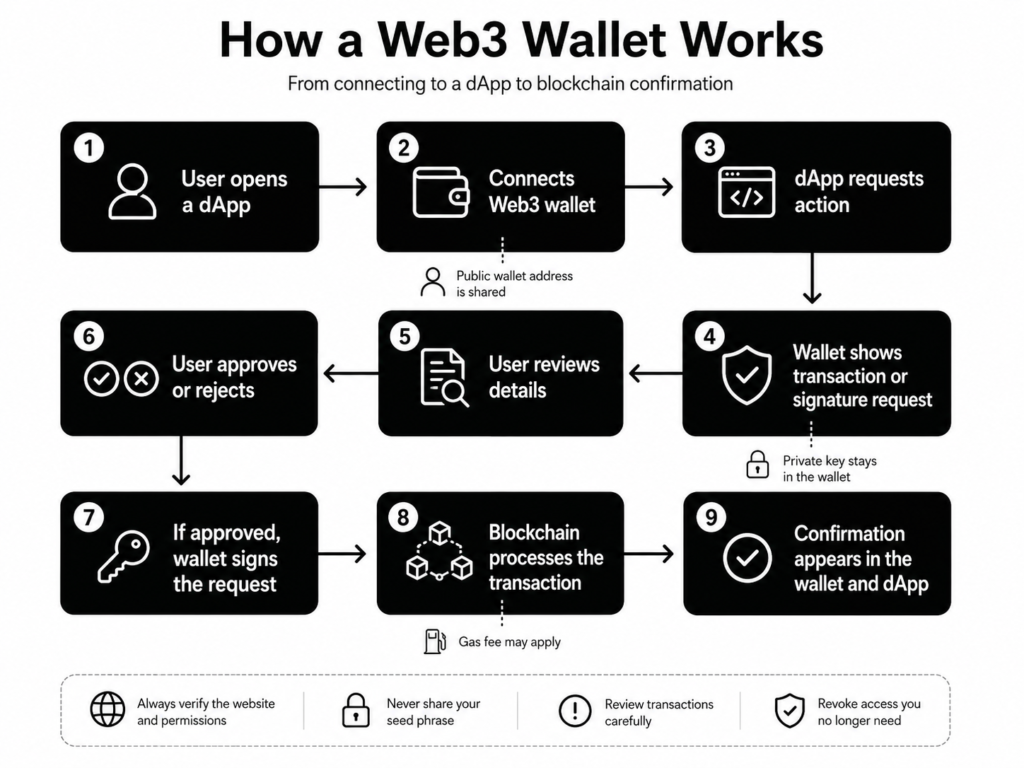
The exact process depends on the blockchain and wallet architecture, but a typical self-custodial wallet involves four connected elements: an account, an address, authorization credentials, and a wallet interface.
The account and address
A blockchain account is identified by an address. Other people can use that address to send assets to the account, and applications can use it to read publicly available blockchain activity.
On Ethereum, an externally owned account is traditionally controlled by a cryptographic key pair. The private key is used to sign transactions, while an address derived from the public key identifies the account. On Solana, a conventional keypair similarly consists of a public key used as the account address and a private key used to sign transactions. The exact address format and cryptographic system vary between networks, so an address that is valid on one blockchain should not automatically be treated as valid on another.
A public wallet address is intended to be shared. A private key is not.
Private keys and recovery phrases
The private key provides the authority to sign actions for a conventional blockchain account. Anyone who obtains it may be able to transfer the assets controlled by that account.
Many wallets generate a recovery phrase, also called a seed phrase or mnemonic phrase. A recovery phrase is not simply a password for opening an application. It can be used to recreate the underlying key material for one or more accounts. BIP-39, a widely implemented wallet specification, describes how mnemonic words can be converted into a seed for deterministic wallet generation.
This distinction has serious consequences. A password may only lock a wallet application on one device, while the recovery phrase can restore the wallet elsewhere. Changing the application password generally does not neutralize a stolen recovery phrase.
Not every Web3 wallet uses a traditional recovery phrase. Some smart-account wallets use programmable recovery systems, multiple signers, passkeys, backup keys, or trusted recovery contacts. Users should therefore examine the recovery method of the particular wallet rather than assume that every product works in the same way. ERC-4337 enables contract accounts to apply their own validation logic instead of relying exclusively on Ethereum’s conventional externally owned account model.
The wallet interface
The wallet interface displays balances, prepares transaction requests, manages networks, and presents approval prompts. It may be a mobile application, browser extension, desktop program, physical signing device, or web interface.
The interface itself is not the blockchain account. In many conventional wallets, a user can restore the same account in another compatible interface by using the correct recovery method. Ethereum’s documentation therefore describes the wallet as a tool or window through which a person interacts with an account rather than as the location where the account itself exists.
Compatibility should never be assumed, however. Different wallets can use different derivation paths, account systems, security models, networks, and recovery methods. A user should confirm compatibility before importing recovery information into any new application.
Signing and blockchain verification
When a user requests a transfer or application interaction, the wallet prepares data for approval. If the user confirms it, the wallet applies the required cryptographic signature or smart-account authorization.
The request is then submitted to the relevant network. Network participants verify that the authorization is valid before the requested state change can be accepted. The private key does not need to be sent to the application or blockchain network; the signature provides proof that the action was authorized by the controlling credential.
This is one reason the wallet confirmation screen matters. The wallet is not merely asking whether the user wants to “continue.” It may be presenting an authorization that becomes binding once signed and accepted by the network.
Connecting, signing, approving, and transacting are different actions
One of the most useful safety lessons for a new Web3 user is that connecting a wallet is not the same as signing a message, approving a token, or submitting a transaction.
These actions are often presented close together, but they have different effects.
| Action | What it normally does | Main question to ask |
|---|---|---|
| Connect | Establishes a session and may share an address, supported networks, or wallet capabilities | Is this the correct application and domain? |
| Sign a message | Proves account control or authorizes data without necessarily creating an immediate on-chain transaction | What exactly does the message authorize? |
| Approve a token | Gives a specified address or smart contract permission to spend tokens up to an allowance | Who is the spender, and how much can it access? |
| Send a transaction | Requests an on-chain state change, such as transferring assets or calling a contract | Are the network, destination, value, fee, and function correct? |
A connection session generally allows the wallet and application to communicate under approved session rules. It does not, by itself, mean that every later request is safe. WalletConnect documentation, for example, defines a session as a connection established after the user approves a proposal; the session remains active until it expires or is disconnected.
A message signature may be used for authentication, account ownership verification, or another off-chain purpose. Some signatures can nevertheless carry financial consequences. ERC-2612, for example, allows a signed message to change an ERC-20 token allowance without using the token’s traditional on-chain approve call first. Users should therefore avoid assuming that a request is harmless merely because the wallet labels it as a signature rather than a transaction.
A token approval creates an allowance that permits another address—usually a smart contract—to spend a specified amount of the user’s tokens. The ERC-20 standard defines this approval and allowance mechanism. Because the permission is recorded in the token contract, closing a website or disconnecting the wallet session does not necessarily remove the allowance. Revocation requires a separate on-chain change unless the permission was temporary by design.
This separation is easy to miss:
Disconnecting ends the application session. Revoking removes the blockchain permission. They are not the same operation.
A realistic Web3 wallet interaction
Consider a user exchanging one token for another through a decentralized application:
- The user visits what they believe is the application’s official website.
- The user connects a compatible wallet and approves a session.
- The application reads the public address and displays the account’s relevant balances.
- If the application needs permission to use an ERC-20 token, it requests an allowance.
- The wallet displays the requested spender, amount, network, and transaction details.
- The user approves the allowance after verifying the information.
- The application prepares the exchange transaction.
- The user reviews and signs that separate transaction.
- The blockchain processes the request, subject to its rules and network conditions.
Several risks can arise before the exchange itself occurs. The website may be an imitation, the requested allowance may be larger than necessary, the wallet may be connected to the wrong network, or the smart contract may be vulnerable or malicious. The presence of a normal-looking wallet prompt does not prove that the requested action is safe.
Web3 wallet types and custody models
Wallets are commonly described by form factor, internet connectivity, custody model, and account architecture. These categories overlap, so a single wallet might be a mobile, self-custodial, hot wallet controlling a conventional key-based account.
Hot and cold wallets
A hot wallet operates on or communicates regularly through an internet-connected device. Browser extensions, mobile applications, desktop wallets, and web wallets are usually considered hot wallets. Their primary advantage is convenience: users can access applications and approve transactions relatively quickly.
Their main weakness is exposure. Malware, malicious browser extensions, compromised devices, phishing pages, and fraudulent software downloads can target the wallet or its user.
A cold wallet keeps signing credentials offline or isolated from an ordinary internet-connected environment. A hardware signing device is the most familiar example. Cold-storage arrangements can reduce the chance that malware directly extracts a private key, but they introduce physical-security, backup, and recovery responsibilities. Investor.gov distinguishes hot and cold wallets on the basis of internet connectivity and notes that cold wallets can still be lost, damaged, or stolen.
A hardware wallet should not be treated as automatic protection from every attack. It can isolate keys, but it cannot make a malicious transaction safe. A user who confirms the wrong destination, approves a harmful contract, or exposes the recovery phrase may still lose control of assets.
Self-custodial and custodial wallets
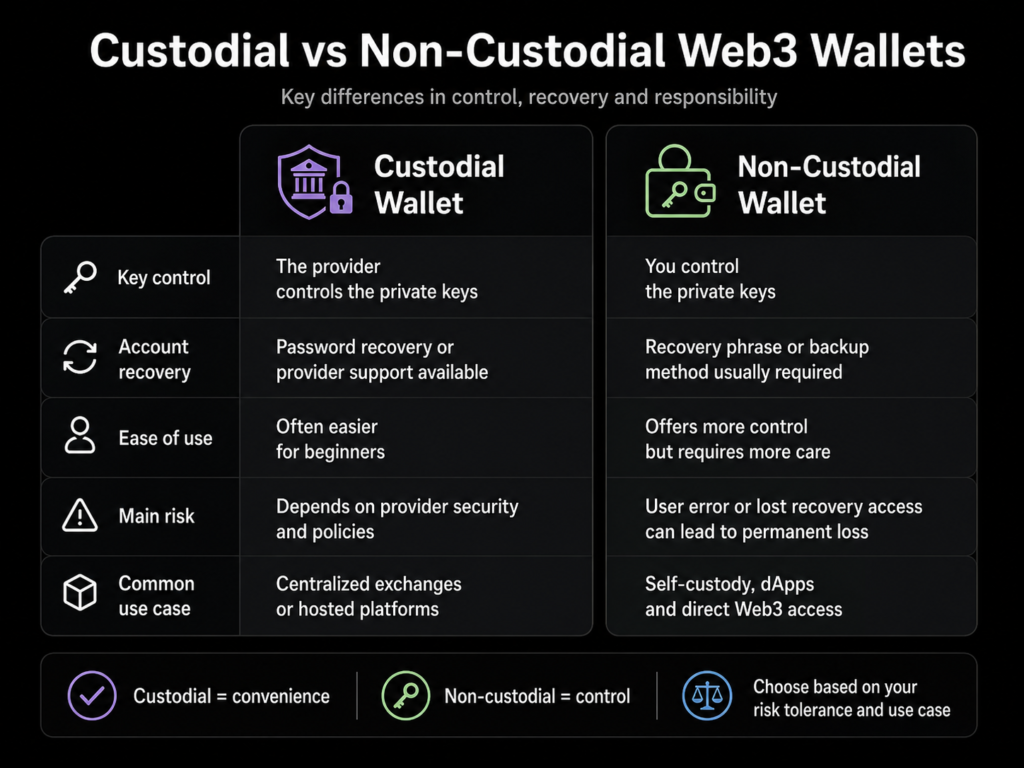
A self-custodial wallet gives the user direct responsibility for the credentials or authorization system controlling the account. The wallet provider generally cannot reset a lost private key, reverse a confirmed blockchain transaction, or restore access without the wallet’s established recovery mechanism.
A custodial wallet involves another party controlling the relevant private keys or withdrawal authority on the user’s behalf. The user may sign in with a password and use account-recovery support, but access ultimately depends on the custodian’s systems, policies, solvency, and security.
Neither model removes risk. Self-custody concentrates operational responsibility on the user, while custody creates dependence on another party. Investor.gov warns that self-custody can lead to permanent loss when credentials are lost or stolen, while third-party custody introduces risks if the provider is hacked, closes, or becomes insolvent.
The phrase decentralized wallet is often used as a synonym for self-custodial wallet, but it is less precise. A user may control the private key while still relying on centrally operated software distribution, remote procedure call infrastructure, application interfaces, or connection services. The meaningful custody question is not whether the marketing page uses the word “decentralized.” It is:
Who can authorize movement from the account, and what happens if the wallet provider disappears?
Conventional and smart-account wallets
A conventional externally owned account relies on a private key to authorize transactions according to the blockchain’s built-in account rules.
A smart-account wallet uses contract code to define some or all authorization behavior. Depending on its implementation, it may support multiple signers, spending limits, batched operations, alternative fee arrangements, account recovery, or role-based permissions. ERC-4337 provides an account-abstraction framework in which UserOperation objects are validated through programmable account logic. Related standards describe capabilities such as custom signature schemes, multisignature configurations, recovery, and batched execution.
Smart accounts can improve usability, but additional code and service dependencies can create different technical risks. Recovery rules, upgrade permissions, guardian arrangements, and contract security should be understood before substantial assets are deposited.
What a Web3 wallet can be used for
A Web3 wallet may support more than basic cryptocurrency transfers. Depending on the wallet and network, a user may be able to:
- Send and receive supported crypto assets.
- Connect to decentralized applications.
- Exchange tokens through smart contracts.
- Use lending, borrowing, staking, or liquidity applications.
- Collect, transfer, or display non-fungible tokens.
- Sign messages to demonstrate account control.
- Participate in decentralized governance.
- Use blockchain games or membership systems.
- Manage multiple accounts or networks.
These capabilities are not universal. A wallet designed for an Ethereum-compatible network may not support Bitcoin or Solana. Even when two networks use similar address formats, assets and transactions on those networks remain separate. Ethereum’s wallet guide specifically warns users to confirm that the sender and recipient are operating on the same network because tokens with similar names can exist on multiple networks and are not necessarily interchangeable.
A wallet may also display assets that the user did not intentionally acquire. Receiving an unknown token or NFT does not make it legitimate. The FBI has documented schemes in which unsolicited NFT airdrops directed non-custodial wallet users toward fraudulent reward claims designed to obtain wallet access or authorization.
The safest response to an unknown asset is generally not to follow embedded links, visit a site named in the token, or approve a claim transaction without independent verification.
Security risks that matter most
A Web3 wallet can be technically well designed and still be used unsafely. Many losses begin with a deceptive request that persuades the user to authorize the attacker.
Recovery-phrase exposure
A recovery phrase may recreate every account derived from the corresponding seed. Anyone who receives it can potentially restore those accounts in another wallet and move the assets.
It should not be shared with support staff, entered into an unsolicited website, pasted into a chat, emailed to oneself, or stored as an ordinary screenshot. Ethereum’s security guidance warns that screenshots may synchronize to cloud storage, creating another route through which attackers can obtain the secret. It also states that no legitimate support service should need a user’s private key or recovery phrase.
An important practical rule is:
A website that unexpectedly asks for a recovery phrase is not “connecting” a wallet. It is asking for control of the wallet.
Phishing and imitation applications
Attackers can imitate wallet websites, browser extensions, customer-support accounts, application interfaces, and token-claim pages. A convincing appearance, secure-looking padlock, promoted search result, or familiar logo does not establish authenticity.
Users should verify the domain independently, avoid installing wallet software through unsolicited links, and confirm the publisher through an official source. The FBI advises users not to follow unsolicited links and never to disclose a private key or seed phrase. The FTC likewise warns that scammers may direct victims to send crypto to an attacker-controlled wallet under the pretense of protecting or recovering funds.
Malicious or misleading signatures
A signature can authenticate a session, approve typed data, authorize token spending, list an asset for sale, or permit another action. The financial meaning depends on the signed data, not on whether a network fee is charged.
“Gasless” does not mean “riskless.” A request can have no immediate transaction fee while still creating an authorization that another party can use later. Users who cannot understand a signature request should reject it rather than rely on the absence of a fee.
Excessive token allowances
An application may request permission to spend only the amount required for one transaction, or it may request a much larger allowance for convenience. A large or unlimited approval expands the amount potentially exposed if the approved contract or spender is malicious or later compromised.
Ethereum’s security guidance recommends limiting smart-contract spending permissions to the amount needed. The ERC-20 standard confirms that an approved spender can transfer tokens within the established allowance.
Users should periodically inspect and revoke allowances that are no longer required. Revocation itself normally requires a blockchain transaction and may involve a network fee.
Wrong addresses and wrong networks
Blockchain transfers usually do not include the same reversal process available for an ordinary card payment or bank transfer. On Ethereum, a confirmed transaction cannot simply be canceled by the wallet provider.
Address-replacement malware can also alter copied wallet addresses. Users should compare the full destination address—or enough independently verified sections to detect substitution—rather than checking only the first and last few characters.
When transferring a meaningful amount to a new destination, a small test transaction can reduce the damage caused by an incorrect address, unsupported network, or configuration error. It does not prove that every later interaction will be safe, but it verifies important details before the larger transfer.
Smart-contract and application risk
A secure wallet cannot guarantee that a decentralized application is secure. Smart contracts can contain coding errors, unsafe upgrade controls, manipulated pricing mechanisms, or malicious functions. An application can also present one description while asking the wallet to authorize something different.
A code audit may provide useful evidence, but it is not a guarantee. Users should examine what was audited, which version was reviewed, whether upgradeable components exist, and whether the application has changed since the audit.
False recovery services
People who have already lost crypto are frequently targeted again. Fraudsters may claim they can reverse a blockchain transaction, retrieve stolen funds, or recover a wallet in exchange for an advance payment, private key, or recovery phrase.
The FTC and Investor.gov both warn that recovery scams commonly demand additional payment or confidential credentials while providing no genuine recovery service.
A victim should preserve transaction records and report the incident through appropriate law-enforcement, consumer-protection, exchange, or platform channels. No private individual should be given the recovery phrase to “investigate” the loss.
How to choose and use a Web3 wallet safely
There is no single wallet that is best for every person. The appropriate choice depends on the networks involved, transaction frequency, amount at risk, recovery needs, technical ability, and whether the wallet will interact regularly with applications.
Before transferring assets, a user should be able to answer the following questions:
Who controls authorization? Determine whether the account is self-custodial, custodial, multisignature, or controlled through smart-account rules.
How does recovery work? Establish whether recovery depends on a phrase, backup key, device, guardian, passkey, custodian, or combination of methods. Confirm what happens if one method is lost.
Which networks are supported? Check both the wallet and the receiving application. Similar token names do not make assets transferable between unrelated networks.
What does the wallet show before approval? Prefer an interface that clearly displays the destination, network, amount, contract, requested function, token allowance, and estimated fee. A technically secure signer is difficult to use safely if the confirmation screen hides meaningful information.
How is the software distributed and maintained? Obtain the application from a verified source, review update history, and confirm that security information and support channels are clearly documented. Open-source availability can improve transparency, but source publication alone does not prove that the installed build is safe.
Can risk be separated? A practical approach is to use different accounts for different purposes. A low-balance wallet can be used for unfamiliar application interactions, while long-term assets remain in an account that rarely connects to websites. This limits the potential impact of one harmful authorization, though it does not eliminate risk.
For routine use, the following practices address the most common failure points:
- Keep recovery material offline and inaccessible to unauthorized people.
- Never provide a private key or recovery phrase to support personnel.
- Verify wallet downloads and application domains independently.
- Review the network, destination, amount, fee, contract, and permission before signing.
- Limit token allowances instead of approving more than necessary.
- Revoke permissions that are no longer needed.
- Use a small test transfer for a new address or network.
- Keep the operating system, browser, and wallet software updated.
- Remove unnecessary browser extensions and avoid using a wallet on a compromised device.
- Separate frequent Web3 activity from long-term asset storage.
No checklist makes cryptocurrency use risk-free. The purpose of these controls is to reduce avoidable exposure and make individual failures less damaging.
Frequently asked questions
Is a Web3 wallet the same as a crypto wallet?
The terms overlap. A crypto wallet manages access to blockchain accounts and assets. A Web3 wallet usually adds the ability to communicate with decentralized applications, sign application requests, and authorize smart-contract interactions.
There is no universal standard that makes every Web3 wallet fundamentally different from every crypto wallet.
Is a Web3 wallet decentralized?
Not necessarily. A wallet may be self-custodial while depending on centrally operated interfaces or infrastructure. Another wallet may connect to decentralized applications while a custodian controls the keys.
“Self-custodial” is generally the clearer term when the user directly controls the account’s authorization credentials.
What is a decentralized Web3 wallet?
The phrase usually refers to a Web3 wallet in which the user, rather than an exchange or custodian, controls the keys or account authorization.
Users should verify the actual custody and recovery model rather than relying on the label. A wallet may describe itself as decentralized while still depending on provider-controlled services.
Does a Web3 wallet store cryptocurrency?
The blockchain records the assets and account state. A conventional wallet stores or manages the keys needed to authorize activity involving those assets. Smart-account wallets may additionally manage programmable authorization and recovery rules.
Is a recovery phrase the same as a private key?
No. A private key controls a particular conventional account. A recovery phrase commonly produces a seed from which multiple private keys and accounts can be derived.
Both must be treated as highly sensitive. In some wallet architectures, the phrase can expose more than one account.
Can a wallet provider recover a lost self-custodial wallet?
A conventional self-custodial wallet provider generally cannot recreate a lost private key or recovery phrase. Recovery is possible only through the methods established when the account was created.
Some smart-account wallets use alternative recovery systems, so users should consult the wallet’s documented recovery design before relying on it.
Does connecting a wallet allow a website to take the funds?
A connection alone normally establishes communication and shares approved account information or capabilities. It does not automatically authorize every transfer.
The website may immediately follow the connection with a message-signing request, token approval, or transaction. Each request must be evaluated independently. A harmful authorization can result in loss even though the initial connection itself did not transfer assets.
Does disconnecting a wallet cancel token approvals?
No. Disconnecting normally ends the active application session. An ERC-20 allowance is recorded in the token contract and remains until it is changed, used, expired under a supported mechanism, or otherwise removed.
Are hardware wallets completely safe?
No. A hardware wallet can reduce direct exposure of private keys to an internet-connected computer, but it cannot protect a user who reveals the recovery phrase or confirms a malicious transaction.
The device’s screen should be used to verify transaction details rather than merely to approve prompts.
Does a Web3 wallet require cryptocurrency?
A wallet can generally be created without first purchasing cryptocurrency. Blockchain transactions may nevertheless require the network’s fee asset.
For example, an Ethereum transaction typically requires ETH to pay its network fee. A message used only for authentication may not require an on-chain fee, although it can still create an important authorization.
Can the same wallet address be used on every blockchain?
No. Some compatible networks can use the same key and address format, but Bitcoin, Ethereum, Solana, and other ecosystems apply different account and transaction rules.
A user should verify the destination network every time. Ethereum’s documentation notes that some Ethereum Virtual Machine-compatible networks can use the same address, while networks such as Bitcoin require different address formats.