



Quick Answer
People searching for buy solana no kyc usually want privacy, faster access, and control over their funds without uploading identity documents to every platform they try.
- Quick Answer
- What “No KYC” Really Means When Buying Solana
- Why People Want to Buy Solana Without KYC
- DEX vs CEX for Buying SOL Without KYC
- 2026 Exchange Reality: Better Tools, More Account Controls
- The Withdrawal Trap: Why Small Test Withdrawals Matter
- Platform Reputation Check: Why Review Scores Matter
- Liquidity and Spread Audit: Why Execution Matters in 2026
- Protection Funds Are Not Deposit Insurance
- No-KYC Policy Watch: What Can Trigger Verification?
- 2026 Context: AI Payments and RWA Infrastructure Are Moving Faster Than Exchanges
- The Cleanest Privacy-First Route
- Setting Up Self-Custody Before Buying SOL
- Step-by-Step: Swap Existing Crypto Into SOL Without a CEX Account
- On-Chain Privacy Is Not Full Anonymity
- P2P Solana Trading
- Regulatory Watch for 2026
- What to Avoid
- Fake No-KYC Exchanges
- Platforms That Require Deposit Before Showing Limits
- “Guaranteed Anonymous SOL” Claims
- Main Wallet Connections
- Best Route by User Type
- Crypnot Research Verdict
- Final Takeaway
- FAQs
- Disclaimer
The cleanest privacy-first route is usually not a direct card or bank purchase. Most fiat on-ramps operate under regulated payment rails and may require identity checks. A more private route usually starts with crypto already in a self-custody wallet, then swapping into SOL through a Solana decentralized exchange aggregator such as Jupiter.
The main risk is the withdrawal trap. Some centralized platforms allow fast signup, deposits, and trading, then request KYC when the user tries to withdraw. Bitunix’s own KYC documentation says withdrawals are considered a regulated service and may require identity verification, while unverified accounts can have restricted access to withdrawal features.
Financial and Legal Risk Note: This guide is educational. It does not encourage users to bypass laws, sanctions, tax duties, or platform terms. Crypto privacy, self-custody, and legal compliance can all matter at the same time.
What “No KYC” Really Means When Buying Solana
KYC means “Know Your Customer.” In crypto, it usually refers to identity checks such as a passport, national ID, selfie verification, proof of address, or payment-source review.
The problem is that “no KYC” is often used too loosely. A platform may mean one of several things:
| Route | What “No KYC” Usually Means | Main Risk |
|---|---|---|
| Decentralized swap | No exchange account or ID upload at protocol level | You need crypto first; wallet and smart contract risks remain |
| Non-mandatory KYC exchange | Some activity may work before verification | Withdrawals may trigger KYC later |
| P2P trade | Buyer and seller transact directly | Fraud, payment reversal, personal safety, and local law issues |
| Crypto ATM | Small purchases may need less ID in some regions | High fees, limits, and local compliance rules |
| Private transfer | Wallet-to-wallet deal with another person | Trust and dispute risk |
The closest practical version of no-KYC SOL access is a wallet-based swap. The user already holds crypto, connects a self-custody wallet, and swaps into SOL without opening a custodial exchange account.
The catch is the first step. A DEX can swap crypto into SOL, but it cannot turn a bank card into SOL without a payment provider.
Why People Want to Buy Solana Without KYC
The search intent is often misunderstood. Not every user looking for buy solana no kyc is trying to hide illegal activity. Many users simply do not want to upload personal documents to every exchange, broker, or verification vendor.
That concern is rational. A passport, selfie, address record, and payment-source data are sensitive. If that data leaks or is mishandled, the user cannot rotate it like a password.
Privacy-focused SOL buyers usually care about:
- Reducing unnecessary document exposure
- Avoiding account sprawl across many exchanges
- Moving SOL into self-custody
- Avoiding custodial withdrawal delays
- Keeping long-term holdings off trading platforms
- Using Solana apps directly from a wallet
Privacy is not the same as lawlessness. Users still need to follow local rules, tax obligations, sanctions restrictions, and platform terms. The better framing is financial privacy with responsible self-custody, not regulatory evasion.
DEX vs CEX for Buying SOL Without KYC
The main choice is between decentralized and centralized routes.
Decentralized Aggregators
A decentralized exchange aggregator routes swaps across liquidity venues. On Solana, Jupiter is one of the most important examples.
Jupiter’s developer documentation describes its Swap API as a unified entry point that can return an assembled transaction, route across engines such as Metis, JupiterZ, Dflow, and OKX, and allow the user to sign and execute the transaction.
You also need to know can you mine solana?
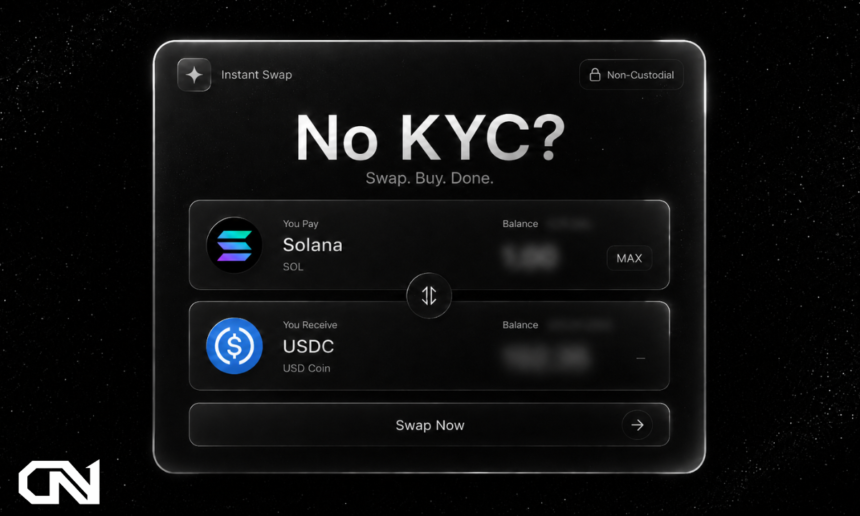
For a normal user, the flow is simple:
- Hold crypto in a Solana wallet, such as USDC.
- Connect a self-custody wallet.
- Select a swap pair, such as USDC to SOL.
- Review the route, price impact, slippage, and minimum received.
- Sign the transaction.
- Receive SOL in the wallet.
There is no normal exchange account in that flow. The user controls the wallet and signs the transaction directly.
The trade-off is responsibility. A DEX route does not give the same support experience as a centralized exchange. A bad signature, fake token, fake site, or wrong transaction can still cause a loss.
Centralized Exchanges With Limited or “Non-Mandatory” KYC
Some centralized exchanges promote fast signup or limited access before full verification. These platforms may look easier because they offer charts, mobile apps, order books, trading bots, futures, support, and fiat-style interfaces.
The problem is custody.
If the exchange controls the wallet, the exchange controls withdrawals. Even if deposits and trading work without full KYC, the platform may request documents during withdrawal, account review, risk-control checks, or limit upgrades.
For a privacy-first SOL buyer, withdrawal freedom matters more than account creation speed.
2026 Exchange Reality: Better Tools, More Account Controls
No-KYC exchange guides from 2024 are already dated. In 2026, some centralized platforms look more advanced. They offer grid bots, copy tools, futures interfaces, risk calculators, mobile trading, USDC-margined contracts, and high-leverage markets.
Bitunix, for example, introduced a Fixed Risk tool in 2026 that calculates futures order size from entry price, stop-loss price, and the user’s maximum acceptable loss. Bitunix says the tool is designed to reduce manual sizing errors, but also warns actual losses can differ because of slippage, execution conditions, fast market movement, or existing positions.
Bitunix also lists Futures Grid Trading, an automated futures strategy that places buy and sell orders inside a selected price range. Its own guide warns that futures grid trading does not guarantee profit and that leverage increases liquidation risk.
Those features may help active traders, but they do not solve the custody question.
An exchange can have advanced trading tools and still request KYC, restrict withdrawals, or place an account under risk review. Better tools do not make a custodial platform equal to self-custody.
For SOL buyers, the question is not “does the app look professional?” The better question is:
Can I withdraw a small amount of native SOL to my own wallet without friction?
The Withdrawal Trap: Why Small Test Withdrawals Matter
The withdrawal trap is the biggest issue in the buy solana no kyc search.
Many users test the wrong thing. They check whether signup is easy. They check whether deposits work. They check whether the trading screen loads. None of that proves the exchange will let them withdraw SOL.
A risky pattern looks like this:
- The platform allows account creation.
- The user deposits funds.
- The user trades into SOL.
- The balance appears normal.
- The user tries to withdraw.
- The platform triggers risk control or KYC.
- Funds remain locked until the review is completed.
Bitunix’s withdrawal FAQ says withdrawal limits depend on account security level and KYC verification level, and accounts with only one security item, such as email, phone, or Google Authenticator, have a daily withdrawal limit of $10,000 equivalent in tokens.
That does not mean every user will have a problem. It does mean buyers should test withdrawals before trusting a platform with meaningful funds.
Before using any centralized platform, run a small test:
- Deposit the smallest practical amount.
- Trade a small amount into SOL.
- Withdraw a small amount of native SOL to Phantom.
- Confirm the transaction on-chain.
- Only then decide whether the platform deserves more trust.
A free comparison of Layer 1 vs Layer 2
Never start with a large deposit. A small test withdrawal is not paranoia. It is basic operational security.
| Check | Why It Matters |
|---|---|
| Withdrawal limits | Some platforms restrict withdrawals more than trading |
| KYC trigger rules | Verification may appear only after deposit |
| Native SOL support | You need real SOL on Solana, not a wrapped or wrong-chain asset |
| User complaints | Repeated frozen-fund reports deserve attention |
| Support quality | Slow support becomes serious when funds are locked |
| Terms of service | Platforms may reserve the right to request KYC anytime |
A platform that lets users deposit and trade but blocks withdrawals during review is not a reliable privacy-first route.
Platform Reputation Check: Why Review Scores Matter
Review scores are imperfect. Some users leave emotional reviews after trading losses. Some complaints may be incomplete. Some positive reviews may not reflect withdrawal risk.
Even so, repeated complaints about frozen funds, risk-control reviews, withdrawal delays, and KYC issues should not be ignored.
Bitunix’s Trustpilot profile was showing a low TrustScore around the 2.5–2.7 range when reviewed, with visible complaints mentioning account restrictions, risk-control reviews, KYC delays, and withdrawal problems. Trustpilot reviews do not prove every allegation, but they are useful for spotting patterns worth testing with small amounts first.
A serious buyer should check:
- Recent withdrawal complaints
- Mentions of “risk control”
- KYC delay patterns
- Whether support replies clearly or with templates
- Whether complaints involve trading losses or actual fund access
- Whether users report successful native SOL withdrawals
Smart buyers do not only ask whether they can buy SOL. They ask whether they can withdraw SOL when needed.
Liquidity and Spread Audit: Why Execution Matters in 2026
Buying SOL privately is not only about KYC. Execution quality matters too.
During calm markets, spreads may look normal and swaps may execute cleanly. During high-volatility periods, spreads widen, order books thin out, and slippage becomes more expensive. This matters more when using centralized platforms with futures tools, leverage, and fast-moving order books.
Bitunix supports up to 200x leverage on selected BTC/USDT and ETH/USDT perpetual futures, and its own guide explains that higher leverage moves liquidation closer to entry and leaves less room for normal market noise.
That is relevant even for SOL buyers who do not use leverage. It shows the trading environment is built for high-speed risk, not just simple spot buying. When a platform focuses heavily on futures, buyers should separate three things:
- Buying SOL for custody
- Trading SOL or futures exposure
- Withdrawing native SOL safely
Do not let trading features distract from the basic custody check.
Before relying on any exchange, review:
| Audit Point | Why It Matters |
|---|---|
| Native SOL withdrawals | Confirms users can control real SOL on Solana |
| Spread during volatility | Wide spreads can make a trade more expensive than expected |
| Order book depth | Thin books can create worse fills |
| Slippage warnings | Helpful if shown clearly before execution |
| Withdrawal test | Proves funds can leave the exchange |
| Risk-control policy | Shows whether the platform can delay account access |
The strongest test remains practical: buy a small amount of SOL, withdraw it to Phantom, and confirm it on-chain.
Protection Funds Are Not Deposit Insurance
Some exchanges use protection funds to build trust. These funds are useful signals, but users should not confuse them with government-backed deposit insurance or guaranteed reimbursement.
Bitunix announced a Bitunix Care Fund with an initial capitalization of 30 million USDC. The company described it as a user protection reserve for unexpected incidents and said it plans transparent operation and regular audits.
That is a positive trust signal, but it does not remove custody risk. It does not guarantee coverage for every loss, trading mistake, liquidation, phishing event, withdrawal review, or user-side error.
A protection fund should be one part of the checklist, not the whole checklist.
For context, Binance’s SAFU reserve has historically been much larger than smaller exchange protection funds. The point is not that one exchange is risk-free and another is unsafe. The point is that fund size, transparency, terms, and withdrawal controls all matter.
For users searching buy solana no kyc, a protection fund does not replace the basic rule:
Move SOL into a wallet you control.
No-KYC Policy Watch: What Can Trigger Verification?
This section matters because “no KYC” is often misunderstood.
Bitunix’s KYC page says identity verification may be required to access certain features, including withdrawals. It also states that withdrawals are a regulated service and are subject to identity verification requirements.
That creates a practical policy map:
| Situation | What Users Should Expect |
|---|---|
| Account signup | May feel fast and low-friction |
| Trading access | Some functions may appear available before deeper checks |
| Withdrawal | Can be subject to identity verification |
| Low-security account | Withdrawal limits may be lower |
| Risk-control trigger | Extra checks may be requested |
| Larger use | Higher limits often require stronger verification |
The important distinction:
| Claim | What It Really Means |
|---|---|
| No-KYC signup | You may be able to create an account without documents |
| No-KYC trading | You may be able to place trades before verification |
| No-KYC withdrawal | You may be able to remove funds without documents |
The third claim is the only one that really matters.
If a platform lets users trade but requires KYC before withdrawal, it is not a clean no-KYC route for buying SOL.
2026 Context: AI Payments and RWA Infrastructure Are Moving Faster Than Exchanges
The crypto market in 2026 is no longer only about spot trading and futures. Two major infrastructure themes are AI-agent payments and real-world asset tokenization.
Circle’s Agent Stack is a good example of where stablecoin infrastructure is moving. Circle says Agent Stack includes Agent Wallets, Agent Marketplace, Circle CLI, Circle Skills, and Nanopayments powered by Circle Gateway, enabling agents to hold funds, discover services, and transact programmatically with USDC. Circle also says Nanopayments can support gas-free USDC transfers as small as $0.000001.
That matters because exchanges that only provide trading access may look less integrated with the next layer of crypto infrastructure. Bitunix has active 2026 trading features, including Fixed Risk, Futures Grid Trading, USDC-margined futures, and 200x leverage on selected BTC and ETH contracts.
From public information available, Bitunix appears more relevant for active trading than for AI-agent payment rails, tokenized asset settlement, or institutional RWA infrastructure. That is not automatically bad for users who only want to trade or buy SOL. It simply means the platform should be evaluated on execution, withdrawals, custody risk, and user controls—not on broader Web3 infrastructure depth.
The Cleanest Privacy-First Route
The cleanest route depends on what the user already has.
If You Already Have Crypto
If you already hold crypto in a self-custody wallet, a Solana DEX aggregator route is usually cleaner.
A common path:
- Hold USDC or another supported token in a Solana wallet.
- Open a trusted Solana swap aggregator.
- Select USDC to SOL.
- Review price impact, slippage, and minimum received.
- Sign the transaction.
- Keep SOL in your own wallet.
This avoids opening a new centralized exchange account. It also avoids leaving SOL inside a platform that can restrict withdrawals.
The limitation is on-chain visibility. Solana is public. No KYC does not mean invisible.
If You Only Have Fiat
If you only have fiat, the route becomes harder.
Cards, bank transfers, and regulated payment rails often involve identity checks. P2P may offer more privacy, but it brings fraud, chargeback, personal safety, and legal risks.
For beginners, a regulated on-ramp for a small first purchase followed by immediate withdrawal to self-custody may be safer than chasing an unreliable no-KYC promise.
Privacy should not come at the cost of losing funds.
Setting Up Self-Custody Before Buying SOL
Buying SOL privately only matters if custody is secure.
Use a Reputable Solana Wallet
Solana’s safety guide warns that users directly control their own assets and are responsible for protecting their wallet and seed phrase. It says a seed phrase gives full wallet access, should never be shared, should not be saved digitally, and should never be entered into websites.
Do not store a seed phrase in:
- Screenshots
- Cloud notes
- Telegram
- Google Drive
- Browser password managers
- Unencrypted phone notes
A wallet is only as safe as the seed phrase behind it.
Use Ledger With Phantom for Larger Balances
For larger SOL balances, use a hardware wallet.
Phantom says it supports Ledger hardware wallets and explains that hardware wallets keep private keys offline while still allowing users to view assets, sign transactions, and interact with apps through Phantom.
Phantom’s Ledger setup guide explains how to connect a Ledger through the Phantom browser extension and notes that users may need to enable blind signing in the Solana app for Solana dApps.
Ledger’s Solana wallet page says Ledger keeps private keys offline on a Secure Element chip while allowing users to buy, send, receive, stake, and manage SOL and SPL tokens.
Blind signing deserves caution. Enable it only when needed and only use trusted apps. If the wallet prompt is unclear, reject it.
Separate Wallets by Purpose
Do not use one wallet for everything.
| Wallet | Use |
|---|---|
| Cold wallet | Long-term SOL storage |
| Hot wallet | Small DeFi activity |
| Test wallet | New apps and unknown links |
| Public wallet | Public payments or visible profiles |
If one wallet interacts with a malicious app, the damage should not reach long-term holdings.
Step-by-Step: Swap Existing Crypto Into SOL Without a CEX Account
A decentralized route works best when the user already holds crypto.
- Open your self-custody wallet.
- Confirm you are using the correct official app or aggregator.
- Check that you hold a supported token on Solana, such as USDC.
- Select SOL as the output asset.
- Review the quoted rate.
- Check price impact.
- Set conservative slippage.
- Check minimum received.
- Sign only after reviewing the transaction.
- Confirm SOL arrived in your wallet.
A DEX swap is irreversible. Avoid high slippage, unknown tokens, fake sites, and rushed approvals.
If the website, token, or wallet prompt feels unclear, stop before signing.
On-Chain Privacy Is Not Full Anonymity
A no-KYC route does not make activity invisible.
Solana is a public blockchain. Wallet balances, transfers, swaps, NFTs, and DeFi activity can be analyzed. A wallet may not display a legal name, but it still leaves a visible transaction trail.
Privacy-conscious users should separate three ideas:
| Concept | Meaning |
|---|---|
| No platform KYC | No ID uploaded to that platform |
| Pseudonymous wallet | Address is public, identity may not be obvious |
| Full anonymity | Much stronger claim and rarely realistic |
A wallet can become linked to identity if it receives funds from a KYC exchange, connects to a public profile, buys identity-linked NFTs, pays a known address, or reuses the same wallet everywhere.
The realistic goal is reasonable financial privacy, not guaranteed invisibility.
P2P Solana Trading
Peer-to-peer trading means buying directly from another person or through a marketplace connecting buyers and sellers.
P2P may reduce reliance on centralized exchanges, but it is not automatically safer.
Risks include:
- Payment reversal
- Fake receipts
- Unsafe counterparties
- Stolen funds
- Bank account reviews
- Local legal issues
- Physical meeting danger
- Escrow disputes
- Impersonator admins
If using P2P, stay conservative:
- Use reputable platforms
- Avoid off-platform deals
- Do not meet strangers with large cash amounts
- Confirm payment finality
- Avoid suspiciously cheap SOL
- Keep records where legally required
- Follow local laws
P2P can offer privacy, but it shifts risk from platform KYC to counterparty trust.
Regulatory Watch for 2026
No-KYC access is getting harder because regulators are tightening standards around crypto platforms.
FATF’s 2025 virtual-asset update said jurisdictions have made progress since 2024 but stronger action is still needed around AML/CFT controls for virtual assets and virtual asset service providers.
Reuters reported that, as of April 2025, only 40 of 138 assessed jurisdictions were “largely compliant” with FATF crypto standards, showing why platforms are tightening compliance controls globally.
In Europe, AML/CFT supervision changed materially in 2026. The European Banking Authority said that on January 1, 2026, AML/CFT mandates and functions moved to the new EU Anti-Money Laundering Authority, AMLA.
For users, the practical effect is clear: centralized platforms are becoming more cautious. Even if an exchange allows limited activity without KYC today, it may request documents later because of regulation, internal risk checks, or jurisdiction rules.
“No KYC today” does not guarantee “no KYC at withdrawal.”
What to Avoid
Fake No-KYC Exchanges
Some sites advertise no-KYC SOL purchases but are phishing pages or weak custodians.
Red flags:
- No clear company information
- Unrealistic prices
- No visible withdrawal rules
- No native SOL support
- No public reputation
- High-pressure deposit bonuses
- Telegram-only support
- Lookalike branding
Platforms That Require Deposit Before Showing Limits
A platform should explain withdrawal limits and KYC triggers before users deposit funds.
If the rules appear only after deposit, the user has already lost leverage.
“Guaranteed Anonymous SOL” Claims
No serious provider can guarantee full anonymity on a public blockchain.
A site promising anonymous SOL with no risk is either misleading or dangerous.
Main Wallet Connections
Do not connect your main wallet to unknown swap sites, new bridges, fake airdrops, or random P2P escrow tools.
Use a test wallet first.
Best Route by User Type
| User Type | Better Route | Reason |
|---|---|---|
| Already has USDC on Solana | DEX aggregator swap | No new account, self-custody, direct SOL output |
| Only has fiat | Regulated on-ramp or careful P2P | Fiat rails usually involve identity or counterparty risk |
| Wants long-term SOL storage | Ledger with Phantom | Keeps private keys offline |
| Wants small DeFi activity | Hot wallet with limited funds | Easier app use with lower exposure |
| Wants better privacy | Self-custody and minimal wallet linking | Reduces document exposure, but not on-chain visibility |
| Beginner | Small test purchase and wallet education | Avoids large first-time mistakes |
Crypnot Research Verdict
The best answer to buy solana no kyc depends on where the user starts.
If the user already has crypto, a Solana DEX aggregator route is usually the cleanest privacy-first option. The user keeps custody, avoids creating a new exchange account, and receives SOL directly in a wallet.
If the user only has fiat, the situation is less clean. Most bank and card routes involve regulated providers that may request identity verification. P2P can offer more privacy, but it brings counterparty, payment, legal, and safety risks.
The strongest privacy-first route is not the platform with the loudest no-KYC marketing. It is the route where users can keep custody, test withdrawals, avoid unclear risk-control triggers, and move SOL into a wallet they control.
The withdrawal trap deserves special attention. A platform that lets users deposit and trade but blocks withdrawals during review is not a true privacy-first route.
For serious users, self-custody comes first. A no-KYC purchase does not help if SOL remains trapped on a custodial exchange or gets stolen from an insecure wallet.
Final Takeaway
Buying SOL without KYC can be possible, especially when the user already has crypto and uses a self-custody route. It becomes harder when the user starts with fiat because regulated payment rails often involve identity checks.
A safer privacy-first path looks like this:
- Get crypto into self-custody legally.
- Use a trusted Solana DEX aggregator to swap into SOL.
- Test every centralized platform with a small withdrawal first.
- Avoid large first deposits.
- Move SOL into self-custody quickly.
- Use Phantom with Ledger for larger balances.
- Remember that no KYC does not mean anonymous.
- Stay aware of AML, Travel Rule, and local compliance trends.
The best version of buy solana no kyc is not about ignoring rules. It is about reducing unnecessary personal data exposure, avoiding custody traps, and keeping SOL under the user’s own control.
FAQs
- Can I buy Solana no KYC?
Yes, but usually only if you already have crypto and swap into SOL through a decentralized route. Fiat purchases often involve KYC. - Is buying SOL without KYC illegal?
Not automatically. It depends on your country, payment method, platform, and purpose. Users must follow local laws and tax rules. - What is the safest no-KYC way to get SOL?
For users who already hold crypto, a self-custody wallet and a trusted Solana DEX aggregator can be safer than a custodial no-KYC exchange. - Can a no-KYC exchange freeze my SOL?
Yes. Some platforms allow deposits without ID but request KYC before withdrawals. Always test withdrawals with a small amount first. - Is Jupiter a no-KYC way to get SOL?
Jupiter is a Solana DEX aggregator, not a fiat exchange. It can help swap existing crypto into SOL through a wallet, but users need crypto first.
Disclaimer
This content is for informational and educational purposes only and does not constitute financial, investment, legal, or tax advice. Cryptocurrency markets are volatile. Always do your own research and consult a qualified professional before making financial decisions.