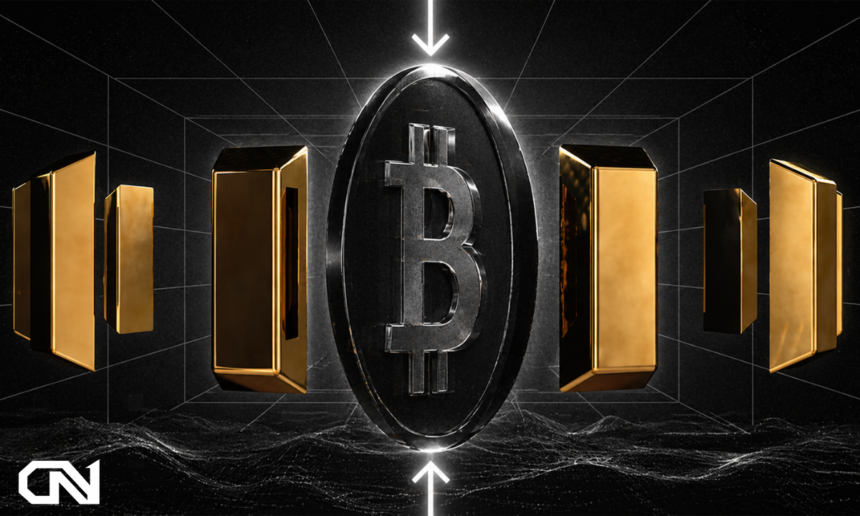

The Bitcoin alchemy analogy compares Bitcoin mining with the ancient idea of turning ordinary materials into something valuable.
- What Does the Alchemy Bitcoin Analogy Mean?
- What Was Traditional Alchemy?
- Why Bitcoin Is Compared to Gold
- Bitcoin Mining: Turning Energy Into Digital Scarcity
- Bitcoin vs Traditional Alchemy
- Where the Analogy Makes Sense
- 1. Bitcoin turns energy into monetary security
- 2. Bitcoin creates scarcity through rules
- 3. Bitcoin removes the need for central trust
- 4. Bitcoin is globally portable
- Where the Analogy Breaks Down
- Bitcoin vs Gold vs Fiat Currency
- Why Institutions Care About Bitcoin Scarcity
- Is Bitcoin Really “Digital Alchemy”?
- Why the Alchemy Bitcoin Analogy Matters
- Final Takeaway
- FAQs
In traditional alchemy, people tried to transform base metals into gold. In Bitcoin, miners use electricity, computing power, and proof-of-work to help create and secure a scarce digital asset.
The comparison is not perfect. Bitcoin is not magic, and mining does not literally turn electricity into gold. But the analogy helps explain one of Bitcoin’s most important ideas: value can be created through scarcity, cost, verification, and trustless digital ownership.
That is why many investors, analysts, and Bitcoin supporters describe Bitcoin as a form of modern digital alchemy.
What Does the Alchemy Bitcoin Analogy Mean?
The alchemy Bitcoin analogy means that Bitcoin transforms something ordinary and physical, energy, into something scarce and digital, BTC -2.20% .
Old alchemists wanted to turn metals like lead into gold. Bitcoin miners do something different, but the logic feels similar. They spend real-world resources to participate in a system that produces limited digital money.
Bitcoin mining uses:
- Electricity
- Specialized computer hardware
- Computational work
- Network participation
- Economic risk
In return, miners can receive newly issued Bitcoin and transaction fees if they successfully add a new block to the blockchain.
This is where the analogy becomes useful.
Bitcoin is not created by a government, a bank, or a company. It is produced through a competitive proof-of-work process. That process makes new Bitcoin costly to create and difficult to fake.
So when people compare Bitcoin to alchemy, they are usually talking about this transformation:
Energy → Computation → Proof-of-work → Digital scarcity → Monetary value
That is the core idea behind Bitcoin as digital alchemy.
What Was Traditional Alchemy?
Traditional alchemy was an old field of thought that mixed philosophy, early science, chemistry, and spirituality.
Its most famous goal was chrysopoeia: the attempt to turn base metals into gold. Alchemists believed that ordinary matter could be purified or transformed into something more valuable.
Today, alchemy is usually remembered as a failed scientific pursuit. But as a metaphor, it still has power.
At its core, alchemy was about transformation.
It asked a simple question:
Can something common become something rare and valuable?
That same question sits at the center of the Bitcoin analogy.
Electricity is common. Computation is measurable. But when both are used inside Bitcoin’s proof-of-work system, they help maintain a scarce digital asset with global liquidity and public verification.
That does not make Bitcoin mystical. It makes the analogy easier to understand.
Why Bitcoin Is Compared to Gold
Bitcoin is often called digital gold because it shares several important properties with gold.
Gold is valuable partly because it is scarce, difficult to mine, durable, and widely recognized as a store of value. Bitcoin was designed with some similar monetary qualities, but in digital form.
Bitcoin has a fixed maximum supply of 21 million BTC -2.20% . No central bank, government, company, or miner can vote to create more Bitcoin beyond that limit without breaking the rules of the network.
That fixed supply is one of Bitcoin’s strongest monetary features.
Bitcoin also has a predictable issuance schedule. New Bitcoin is issued through mining, and the block reward is reduced through halving events roughly every four years. This makes Bitcoin’s supply growth more transparent than many traditional monetary systems.
The digital gold comparison comes from three main properties:
- Fixed maximum supply
- Costly production through mining
- Independent verification through the blockchain
But Bitcoin also has features gold does not have.
Bitcoin can be sent globally without physical transportation. It can be divided into very small units. Its supply can be verified on-chain. Ownership can be transferred without relying on the traditional banking system.
This is where the alchemy Bitcoin analogy becomes stronger.
Gold is scarce by nature.
Bitcoin is scarce by design.
Bitcoin Mining: Turning Energy Into Digital Scarcity
Mining is the strongest part of the alchemy Bitcoin analogy.
Bitcoin miners use energy and computing power to secure the network, validate transactions, and compete to add new blocks to the blockchain.
This process is called proof-of-work.
Proof-of-work forces miners to perform real computational work before they can earn rewards. That work is costly. It requires machines, electricity, maintenance, and operational discipline.
This cost is important because it helps protect the network from cheap manipulation.
A miner cannot simply create Bitcoin for free. A bad actor cannot easily rewrite Bitcoin’s transaction history without controlling enormous computational power and spending massive energy.
That is why Bitcoin mining is often described as a bridge between the physical world and the digital world.
The physical world provides energy.
The digital world receives security, scarcity, and settlement.
This is the modern version of the alchemy metaphor.
Bitcoin does not create value from nothing. It creates a system where value is connected to verifiable cost, open rules, and network consensus.
Bitcoin vs Traditional Alchemy
The analogy becomes clearer when both ideas are compared directly.
| Traditional Alchemy | Bitcoin Analogy |
|---|---|
| Tried to turn base metals into gold | Uses energy and computation to secure scarce digital money |
| Relied on secret formulas and mystical ideas | Relies on open-source code and public verification |
| Searched for physical gold | Produces digital scarcity through proof-of-work |
| Was difficult to prove scientifically | Can be verified through the blockchain |
| Depended on belief and experimentation | Depends on cryptography, consensus, and economic incentives |
| Failed as a practical way to create gold | Works as a decentralized monetary network |
This table shows where the analogy works and where it does not.
Bitcoin is not alchemy in the historical sense. It does not magically transform matter. But it does transform economic input into digital monetary security.
That is why the comparison remains powerful.
Where the Analogy Makes Sense
The alchemy Bitcoin analogy makes sense in four main ways.
1. Bitcoin turns energy into monetary security
Miners spend electricity to perform proof-of-work. This process protects the network and helps issue new Bitcoin according to the protocol’s rules.
The energy is not turned into Bitcoin in a literal chemical sense. Instead, energy is used to secure the system that makes Bitcoin valuable.
2. Bitcoin creates scarcity through rules
Gold is scarce because the Earth has a limited supply and mining it is difficult.
Bitcoin is scarce because the protocol limits total supply to 21 million coins and controls issuance through mining rewards.
That makes Bitcoin’s scarcity engineered rather than naturally discovered.
3. Bitcoin removes the need for central trust
Fiat money depends heavily on governments, central banks, and monetary policy.
Bitcoin depends on open-source rules, proof-of-work, and decentralized network participants.
This does not make Bitcoin risk-free, but it does make it different from traditional money.
4. Bitcoin is globally portable
Gold is heavy, physical, and difficult to move across borders.
Bitcoin is digital. It can be transferred across the internet without physically moving anything.
This is one of the reasons Bitcoin supporters see it as a modern upgrade to the store-of-value idea.
Where the Analogy Breaks Down
The analogy is useful, but it should not be taken too far.
Bitcoin is not magic. It is software, cryptography, economic incentives, and network consensus.
There are also real criticisms.
Bitcoin mining uses large amounts of electricity. Critics argue that this creates environmental pressure and may not be justified by the network’s benefits.
Supporters argue that mining can use stranded, excess, or renewable energy and that the energy cost is part of what secures the network.
Both sides matter.
Another limitation is volatility.
Gold has thousands of years of history as a store of value. Bitcoin is much younger and its price can move sharply in short periods. That makes Bitcoin attractive to some investors but risky for others.
So the better way to understand the analogy is this:
Bitcoin is like alchemy as a metaphor for transformation, not as a claim of guaranteed value or risk-free wealth.
Bitcoin vs Gold vs Fiat Currency
| Feature | Bitcoin | Gold | Fiat Currency |
|---|---|---|---|
| Supply limit | Fixed maximum supply of 21 million BTC | Naturally limited | No fixed hard cap |
| Creation process | Proof-of-work mining | Physical mining | Central bank issuance |
| Verification | Public blockchain | Physical reserves and audits | Institutional reporting |
| Portability | Digital and global | Physical and heavy | Digital but bank-dependent |
| Divisibility | Highly divisible | Divisible but less practical | Highly divisible |
| Inflation resistance | Built into supply rules | Historically scarce | Depends on monetary policy |
| Trust model | Code, miners, nodes, consensus | Market trust and physical custody | Government and central banks |
This comparison explains why Bitcoin is often placed between gold and modern money.
Like gold, Bitcoin has scarcity.
Like fiat, Bitcoin can move digitally.
But unlike fiat, Bitcoin does not rely on a central issuer to control supply.
That combination is why the alchemy Bitcoin analogy continues to appear in discussions about digital money.
Why Institutions Care About Bitcoin Scarcity
The alchemy idea is not limited to miners.
It also applies to investors and institutions.
When a company, fund, or long-term holder buys Bitcoin, they are converting traditional capital into a scarce digital asset.
The logic is simple:
Fiat capital → Bitcoin reserves
Inflation exposure → Scarce digital asset
Centralized money → Decentralized ownership
This is why Bitcoin treasury strategies have become part of the broader financial conversation.
You can also track the latest bitcoin news.
Some investors see Bitcoin as a hedge against currency debasement. Others see it as a high-risk digital asset with long-term upside. Some treat it as a portfolio diversifier.
The key point is that Bitcoin’s value narrative is built around scarcity, not cash flow.
Bitcoin does not produce revenue like a company. It does not pay interest like a bond. Its investment case depends on adoption, liquidity, security, scarcity, and market demand.
That makes it powerful, but also risky.
Is Bitcoin Really “Digital Alchemy”?
Bitcoin can be called digital alchemy in a metaphorical sense.
It transforms energy and computation into a secure monetary network. It turns open-source code into enforceable scarcity. It allows ownership to move globally without needing the same intermediaries used in traditional finance.
But the phrase should be used carefully.
Bitcoin is not valuable just because miners spend electricity. Energy cost alone does not create value. The value comes from the full system:
- Scarcity
- Network security
- Decentralization
- Liquidity
- Adoption
- Trust in the protocol
- Demand from users and investors
Mining is only one part of the equation.
This is where many simple explanations get Bitcoin wrong.
Bitcoin is not “electricity turned into money” by itself. It is a monetary network secured by energy, mathematics, incentives, and consensus.
That is a much stronger and more accurate explanation.
Why the Alchemy Bitcoin Analogy Matters
The alchemy Bitcoin analogy matters because it gives people a simple way to understand a complex idea.
Bitcoin is not just a price chart.
It is a system for creating and transferring scarce digital value without a central issuer.
That idea challenges the normal way people think about money.
In the fiat system, money supply can expand through central bank policy, lending systems, and government decisions.
In Bitcoin, supply follows transparent protocol rules.
That difference is the reason Bitcoin attracts long-term believers, institutional investors, miners, technologists, and critics at the same time.
For supporters, Bitcoin is hard money for the digital age.
For critics, it is volatile, energy-intensive, and difficult to value.
Both views are part of the debate.
The alchemy analogy does not prove that Bitcoin will always rise in price. It simply helps explain why Bitcoin is different from traditional money, gold, and most digital assets.
Final Takeaway
The alchemy Bitcoin analogy compares Bitcoin’s proof-of-work system with the ancient dream of turning ordinary materials into gold.
Traditional alchemists tried to transform base metals into precious metals.
Bitcoin miners use electricity, hardware, and computation to secure a scarce digital monetary network.
That is why Bitcoin is often described as digital gold or digital alchemy.
The analogy works because Bitcoin connects physical cost with digital scarcity. It breaks down if people treat it as magic or as a guarantee of future value.
A balanced understanding is better:
Bitcoin is not financial magic.
It is a decentralized monetary system where scarcity is enforced by code, security is supported by proof-of-work, and value depends on adoption, trust, and market demand.
That is the real meaning behind the alchemy Bitcoin analogy.
FAQs
What is the alchemy Bitcoin analogy?
The alchemy Bitcoin analogy compares Bitcoin mining with the old idea of turning ordinary materials into gold. In Bitcoin’s case, miners use electricity and computing power to help secure a scarce digital asset.
Why is Bitcoin compared to gold?
Bitcoin is compared to gold because it has a fixed supply, requires effort to produce, and is often used as a store-of-value asset. Unlike gold, Bitcoin is digital and can be transferred globally.
Does Bitcoin mining literally turn electricity into money?
No. Bitcoin mining does not literally convert electricity into money. Electricity powers the machines that perform proof-of-work, secure the network, validate transactions, and compete for mining rewards.
Why is Bitcoin called digital gold?
Bitcoin is called digital gold because it is scarce, decentralized, durable as a digital asset, and not controlled by a central issuer. Its total supply is capped at 21 million BTC -2.20% .
Is Bitcoin better than gold?
Bitcoin and gold serve different purposes. Gold is older, more stable, and widely recognized. Bitcoin is digital, portable, transparent, and scarce by design, but it is also more volatile.
Is the alchemy Bitcoin analogy accurate?
The analogy is useful, but not perfect. It helps explain how Bitcoin connects energy, proof-of-work, and digital scarcity. But Bitcoin is not magic; it is a technical and economic system.